Celebrating 35+ Years


A Practical Guide to Wallpaper Repeat Patterns
A dramatic floral can look perfectly balanced in a sample, then feel oddly interrupted across a full wall if its repeat is not considered before ordering. This guide to wallpaper repeat patterns explains the small specification that makes a major difference in both the finished look and the number of rolls your project requires.
Wallpaper repeats are not a reason to avoid a favorite print. They are simply part of planning well. Once you know how a pattern aligns from strip to strip, you can choose with confidence, allow for the right amount of material, and help your installer create a polished result.
Guide to Wallpaper Repeat Patterns: The Basics
A wallpaper repeat is the vertical distance between one complete instance of a design and the next identical point in that design. It may be a modest 10 inches on a small geometric, or 25 inches or more on a large-scale botanical or scenic print.
That measurement matters because wallpaper is hung in vertical strips, called drops. To make the design flow across the wall, each new drop may need to be shifted up or down until its motifs line up with the previous one. The trimmed-off portion is called pattern waste.
A repeat is not a sign of lower efficiency or a flaw in the paper. It is the natural trade-off for scale and visual movement. Large palms, winding vines, expressive murals, and traditional damasks often need more careful matching because their detail is meant to travel across the room as one continuous design.
The Main Wallpaper Match Types
The label or product details should identify the match type as well as the repeat measurement. These terms tell you how the design will align as it is installed.
Random match or free match
Random match wallpaper has no set alignment requirement. Each strip can be hung beside the next without trying to connect motifs at a precise point. Textures, grasscloth-inspired looks, subtle striations, and some abstract prints may fall into this category.
This is often the most economical option because it creates minimal waste. It can also feel more forgiving for a first wallpaper project. Still, look closely at the sample: natural-material wallcoverings can have intentional color and texture variation, which is different from a printed pattern repeat.
Straight match
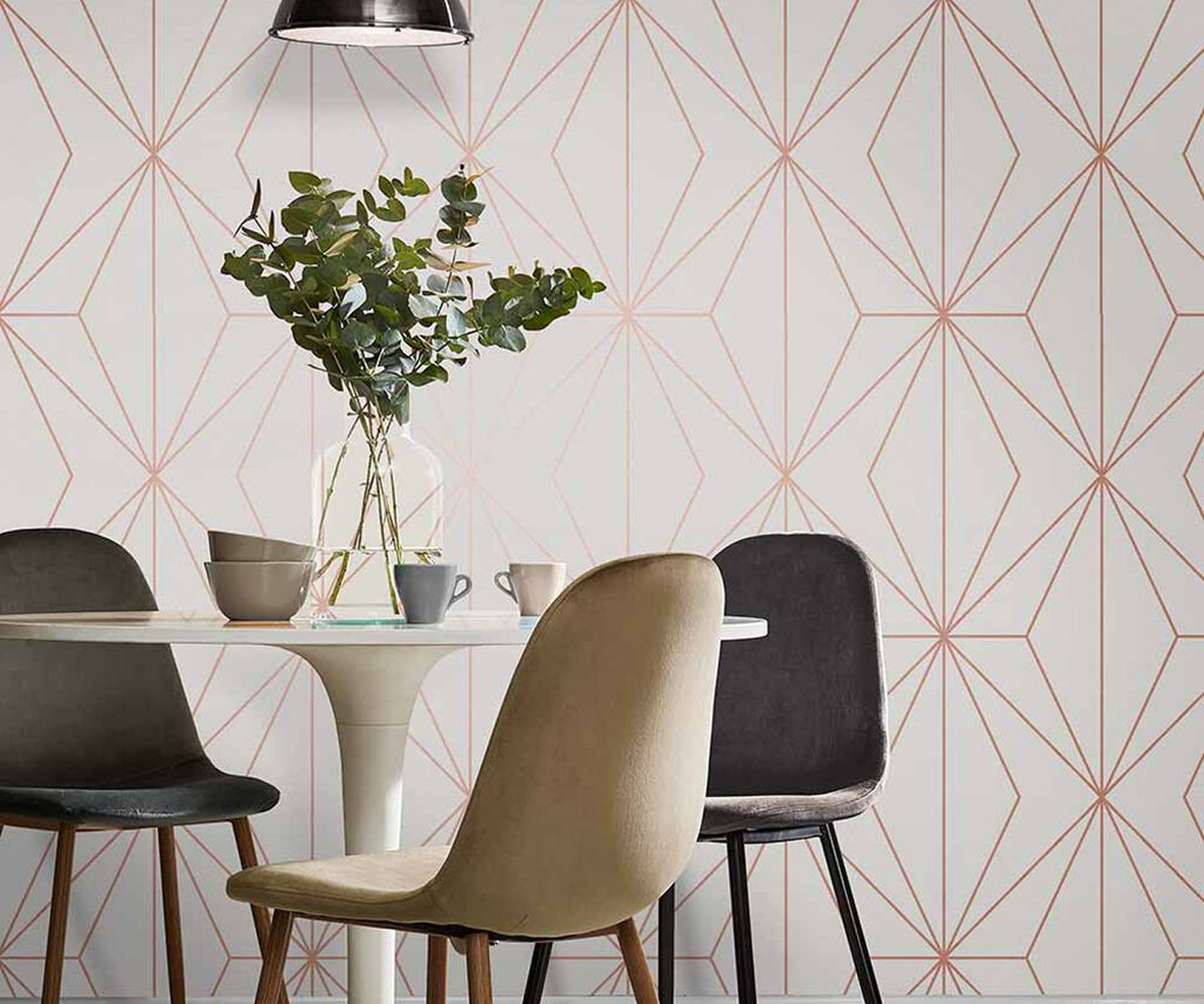
With a straight match, the design lines up horizontally at the same height on every strip. If a flower or geometric shape starts 12 inches down on the first drop, the same element should begin 12 inches down on the next.
Straight-match papers are easy to visualize because the pattern travels cleanly across the wall. They do require trimming to position each drop correctly, but usually create less waste than a drop match with the same repeat. Many classic trellises, stripes, checks, and balanced florals use a straight match.
Drop match and half-drop match
A drop match requires each adjacent strip to be offset vertically so the pattern connects. In a half-drop match, the next strip is shifted by half the repeat measurement. For example, a paper with a 24-inch repeat may require the second strip to begin 12 inches lower than the first.
This arrangement gives wallpaper a more natural, less grid-like rhythm. It is common in large florals, botanical designs, watercolor effects, and many contemporary patterns. It also produces more waste, especially when the repeat is large. The effect can be worth it: a sweeping design with an obvious drop match often brings more depth and movement to a dining room, bedroom, or statement wall.
Some products are listed simply as a drop match rather than a half-drop match. Follow the manufacturer’s instructions and the installer’s layout plan. The exact offset can vary, and guessing can lead to a frustrating shortage late in the project.
Why Repeat Size Changes Your Roll Count
Wallpaper is ordered by coverage, but not every inch of a roll ends up on the wall. A larger repeat can mean that more material is trimmed away at the top and bottom of each drop to preserve alignment.
Wall height is the first part of the calculation. Then you need to account for the width of each wall, windows and doors, the roll dimensions, and the pattern match. A room with eight-foot ceilings may seem straightforward, but a 27-inch repeat can change the usable yield of every roll. Narrow walls can be especially inefficient because a full drop is still needed even when only a small section is being covered.
For this reason, do not subtract every window and door from your estimate. Openings may reduce the number of drops needed, but they rarely eliminate all waste. Extra material also provides insurance for trimming, corners, future repairs, and the occasional unexpected issue behind a switch plate.
A wallpaper calculator is a useful starting point, particularly for a simple rectangular room. For high-repeat patterns, angled ceilings, stairwells, large openings, or a feature wall with multiple turns, it is wise to review the dimensions with a wallpaper specialist or experienced installer before placing the order.
Choose the Repeat for the Room, Not Just the Sample
A bold repeat can make a compact powder room memorable. In a larger living room, a small repeat can create a tailored, layered backdrop without competing with furniture, art, or window treatments. Neither choice is automatically better. The right scale depends on what the room needs.
If you want wallpaper to be the focal point, consider a design with a clear motif and a medium or large repeat. Give it enough open wall space to be seen. A botanical pattern behind a bed, a graphic print in a foyer, or a scenic design around a breakfast nook can transform an ordinary surface into a defining design element.
If the room already has strong tile, patterned upholstery, or detailed architectural features, a smaller repeat or textured wallcovering may be the better partner. It brings color and dimension without making the space feel busy. In rooms with low ceilings, a vertical stripe or elongated motif can also encourage the eye upward, though careful matching remains essential.
Always view a sample at home before deciding. Tape it to the intended wall and look at it in morning light, evening light, and with the room’s existing finishes. Ask to see enough of the design to understand its scale. A single small swatch may not reveal how widely spaced a motif is or how a drop match will move across the wall.
Planning for a Cleaner Installation
Before installation begins, check that all rolls have the same run or batch number when applicable. This helps ensure the color is consistent from roll to roll. Inspect the labels for the repeat, match type, direction of hang, and any special instructions for prepasted, non-woven, vinyl, grasscloth, or other wallcovering materials.
A professional installer will usually decide where the first drop should begin so the room’s most visible wall receives the most attractive pattern placement. That decision is especially important with large motifs. Centering a prominent flower behind a vanity mirror or a bed can look intentional; splitting it awkwardly at the focal point can distract from an otherwise beautiful design.
Corners deserve planning too. Walls are not always perfectly square, and carrying a large pattern around a corner may create a slight visual shift. An installer may prioritize the main viewing wall and use a less noticeable corner for adjustments. This is normal craftsmanship, not a failed match.
For projects with a directional print, keep every drop oriented the same way. Some designs have a clear top and bottom, while others show subtle tonal variation that becomes obvious if a strip is accidentally reversed. When in doubt, review the label before cutting.
A Smart Way to Shop Patterned Wallpaper
Start with the feeling you want the room to have, then narrow by color, material, and pattern scale. Once you have a few favorites, compare their repeat measurements and match types alongside their appearance. A smaller repeat may be more material-efficient, but it should not automatically win over the print that makes the room feel complete.
For Atlanta-area shoppers, Wallpaper and Stuff offers the advantage of seeing a broad selection in person at its Smyrna showroom, where scale, texture, and color are easier to judge beyond a screen. Samples remain valuable for every project, whether you are shopping locally or planning a room from home.
The most successful wallpaper projects leave room for both beauty and practical planning. Choose the print that gives your space character, order with its repeat in mind, and let the finished wall show the design exactly as it was meant to be seen.